Key takeaway
Off-page SEO is what the rest of the web says about your business: your Google Business Profile and its reviews, your directory listings and links from other sites. You need it once your website clearly says what you do and where, not before. Then the order is profile and reviews, matching listings, and a few real links last.
Off-page SEO is everything away from your own website that tells Google your business is real and worth showing. For a local business, that's your Google Business Profile and its reviews, your listings on sites like Yell, and links from other websites. On-page SEO is the other half: the work on your own site.
Do you need it yet? Only once your website says clearly what you do and where. Until then, reviews and links have little to attach to, and most of the effort is wasted. So fix the site first, then your Google profile and reviews, then your listings, and leave links until last. Not sure which side your site is missing? There's a test further down that you can do on your phone.
Off-page is also the part of SEO that fills your spam folder with offers of "high authority backlinks". Everything below is how we handle off-page work for our own clients, with their real figures where we have them.
On-page vs off-page: the difference
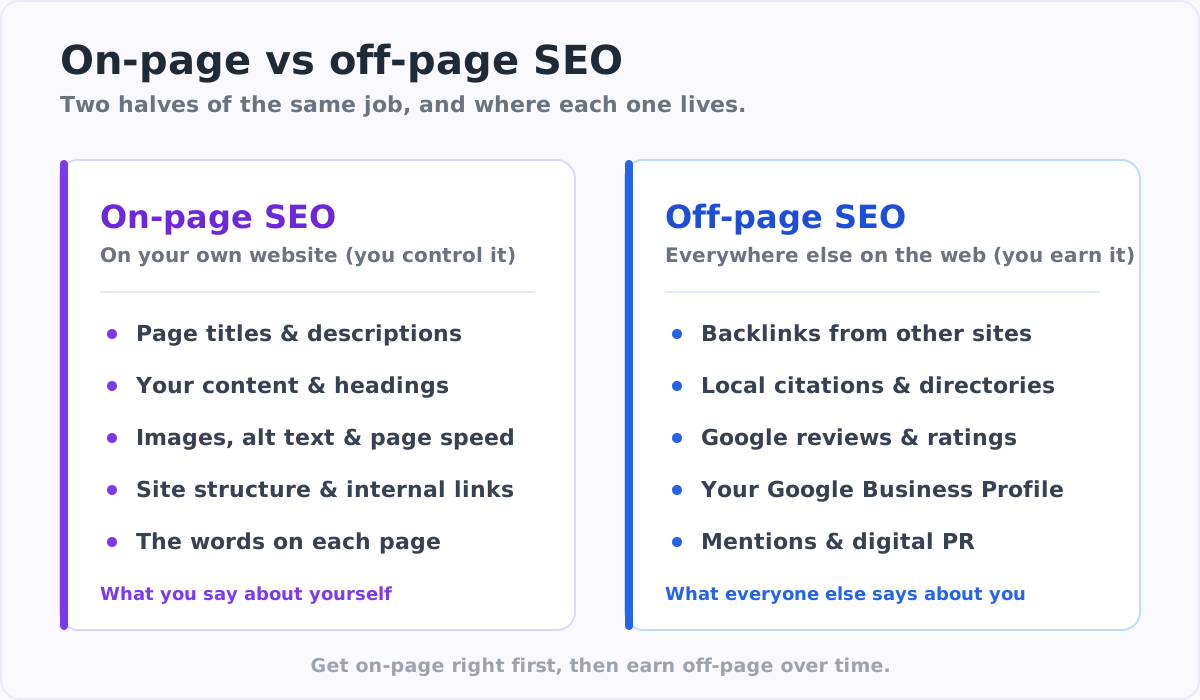
On-page SEO is everything on your own website: page titles, headings, the words on each page, images, how fast it loads. If you can log in and change it, it's on-page. Our plain-English guide to on-page SEO covers it in full.
Off-page SEO is everything the rest of the web says about you. You don't control it directly. You earn it.
Put simply, on-page is what you say about yourself, and off-page is what everyone else says about you.
Which comes first? On-page, then off-page
Picture two questions Google asks about your business. What do you do, and where? And how far should it trust you? It can't do much with the second until it has answered the first. That's a simplification, but it matches what we see on client sites.
Every review, listing and link is a vote for you, and a vote needs somewhere to land. A review that says "sorted our boiler in Derby" counts for a lot more when your site has a page about boiler repair in Derby. If all you've got is one page called "Services" with three lines on it, that review has very little to attach to.
Think of your website as the van: sign-written, clean, number on the side. Off-page is your reputation around town. A great reputation pointing at an unmarked van with no number on it gets you nowhere.
There's a money reason too. On-page is mostly a one-off fix. Do it properly once, then keep it tidy when you add a service or a town. Off-page never really stops, because reviews, listings and links build up over months. Paying monthly for off-page work while the website is still broken is the most common way we see local businesses waste an SEO budget.
Coppermill Landscapes in Chesterfield shows the order working. We built Ross a new site with the on-page SEO done from day one and set up his Google Business Profile properly. He's never paid for monthly SEO. His clicks from Google search still went from 17 in August 2025 to 113 in March 2026, all from the new site, its on-page SEO and the profile.
A quick test: is your site missing on-page or off-page?
You don't need a tool. Open Google on your phone, search for your main job and your town (say, "boiler repair Derby") and see where you land. Then match what you see against these.
It's an on-page problem if
Google can't tell what your site is for
- You're barely appearing, even on page five, for searches you'd expect to be in.
- The wrong pages rank: your homepage shows up for a search your kitchen page should own.
- Every page is called Home, About, Services or Contact, and none of them mention the towns you work in.
Fix Titles, a page per service and area, real content, speed. Reviews alone are unlikely to move this.
It's an off-page problem if
Google understands you, it just trusts the others more
- You're on page two or three for the right searches, behind firms with more Google reviews.
- Your service pages rank, but you're nowhere in the map pack, the box of three at the top.
- Your name, number or address are different on your website, your Google profile and the directories.
Fix Google Business Profile, steady reviews, matching listings, then a few real links.
Both?
Fix on-page first. Then build the reputation that points at it.
One business can get both answers. On 29 October 2026 we searched Coppermill's main jobs on a phone in Chesterfield. It came first in the map pack for "landscapers chesterfield", so the profile and reviews were doing their job. For "resin driveways chesterfield" it wasn't in the top 30. That's a page problem. The resin driveways page isn't yet the best answer in town for that job, and it's the next thing we're working on.
What counts as off-page SEO, in the order to do it
For a local service business it comes down to three jobs. Here they are in the order we do them. It's close to the reverse of how much the cold emails go on about them.
1. Your Google Business Profile and reviews
Your Google Business Profile is the free listing that shows your reviews, opening hours and phone number on Google and Google Maps. It feeds the map pack, the box of three local businesses at the top of a local search. For anyone selling locally it's the biggest off-page lever there is, and it costs nothing. Here's how to get into the map pack, verification headaches and all.
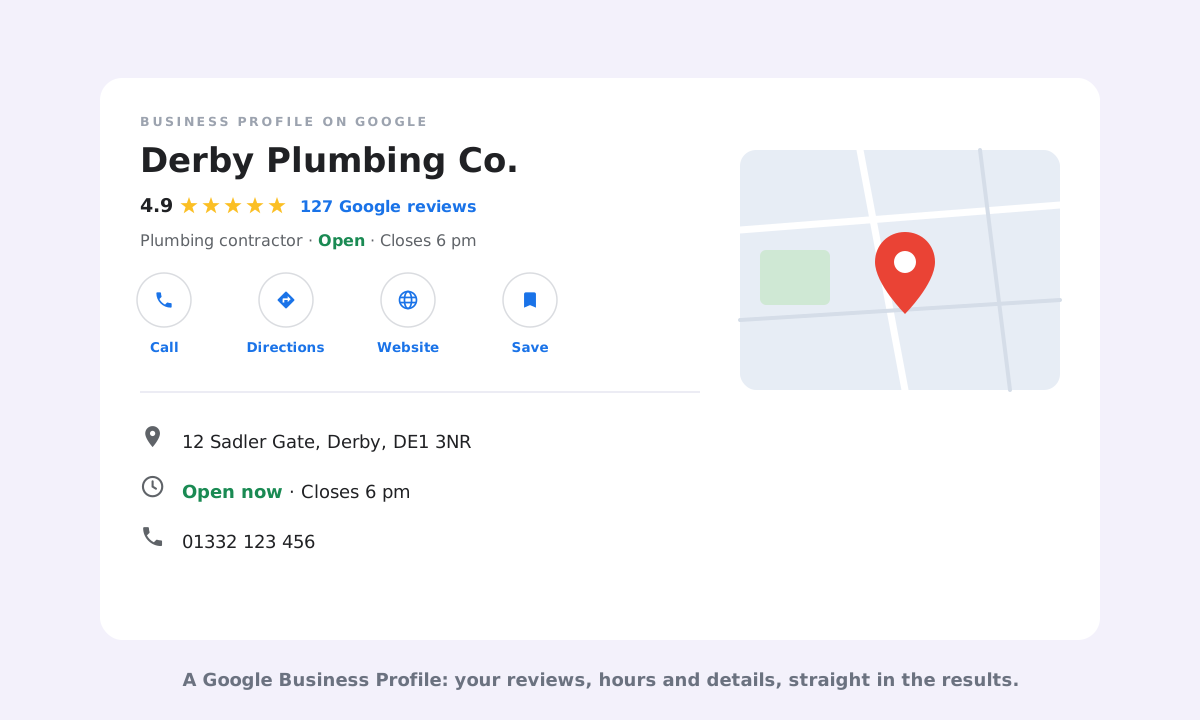
Reviews are a big part of who gets into that box. Google's own help page on local ranking says the number of reviews and the star rating count towards it. A steady trickle of real reviews will usually do more for a plumber or a landscaper than any link package.
Coppermill's profile shows what that's worth. From May to September 2026 it sent Ross 22 phone calls and 143 clicks to his website. In the same five months of 2025 it sent 2 calls and 22 clicks. He has 24 Google reviews, all five stars.
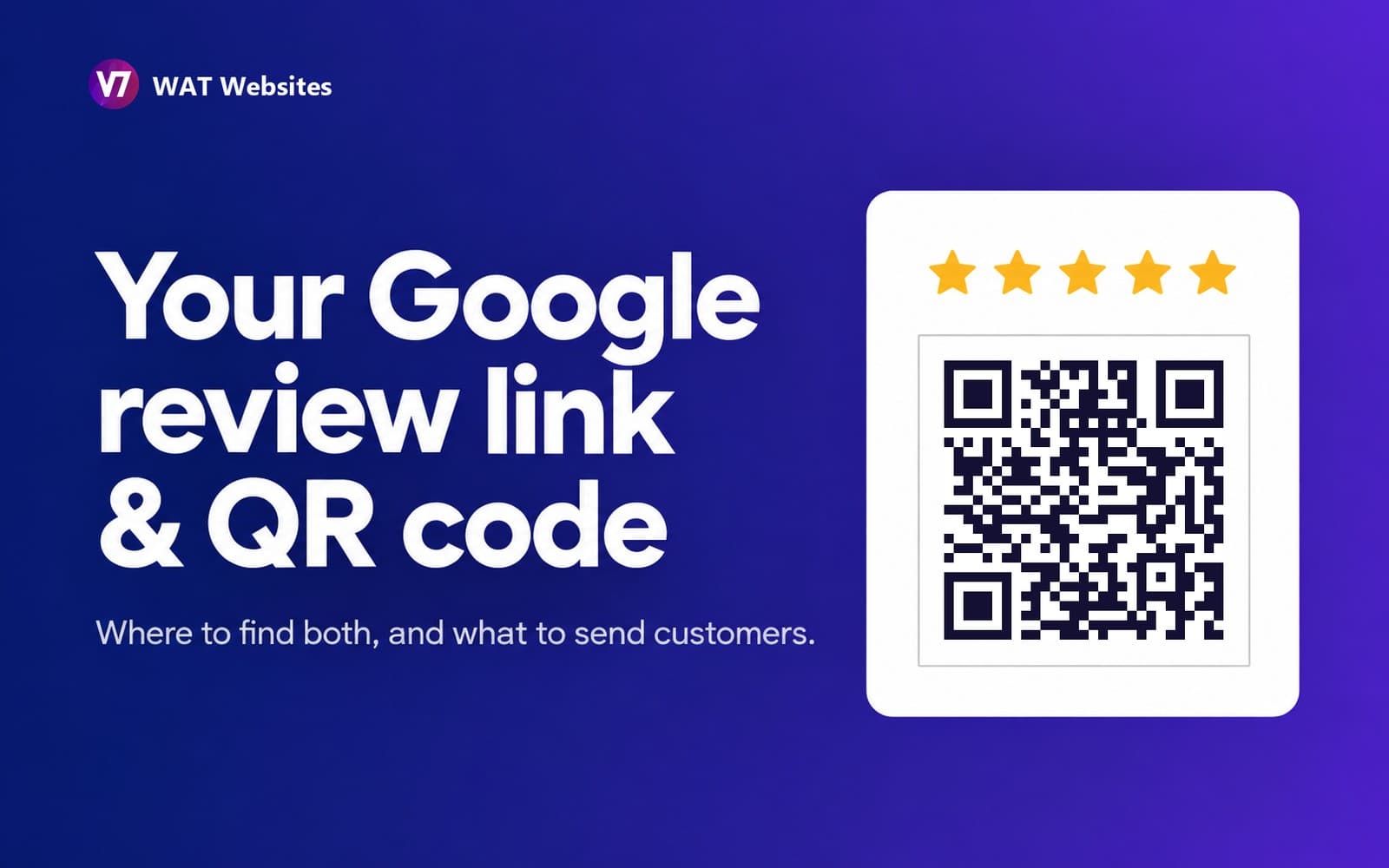
Asking for reviews is the job everyone means to do and forgets. That's why we set clients up with a review system. It's a short link and QR cards that open your Google review box in one tap. Asking takes seconds at the end of a job.
The map pack is also the part of Google that AI answers have changed least. Someone searching for an electrician still needs an electrician, so Google still shows the map pack. There's more on that in our post on AI Overviews.
2. Citations: your details, the same everywhere
A citation is any website that lists your business name, address and phone number, your "NAP" for short. Think Yell, Checkatrade, trade directories and local listing sites. Hardly anyone clicks on most of them. Google uses them to check you're a real business working where you say you are.
What matters is that they match. Same name, same address, same phone number on every one. If half the web has your old mobile and the other half has your landline, it quietly works against you.
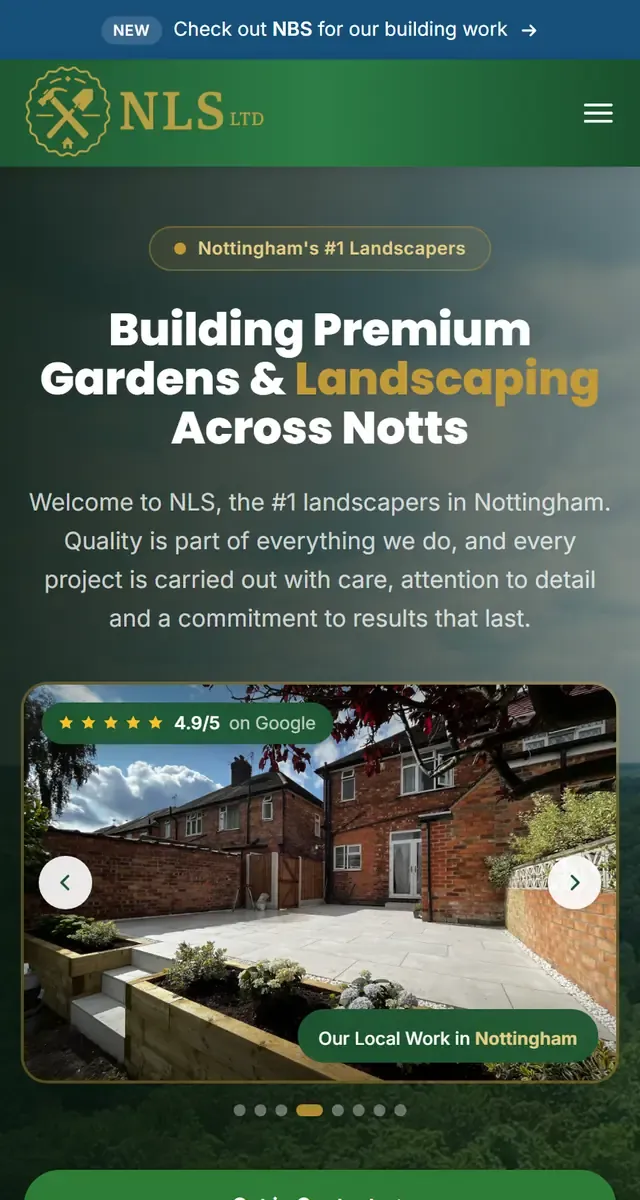
Here are three we set up for Nottingham Landscaping Services, with the same name, phone number and website on Cylex, Houzz and ProvenExpert.
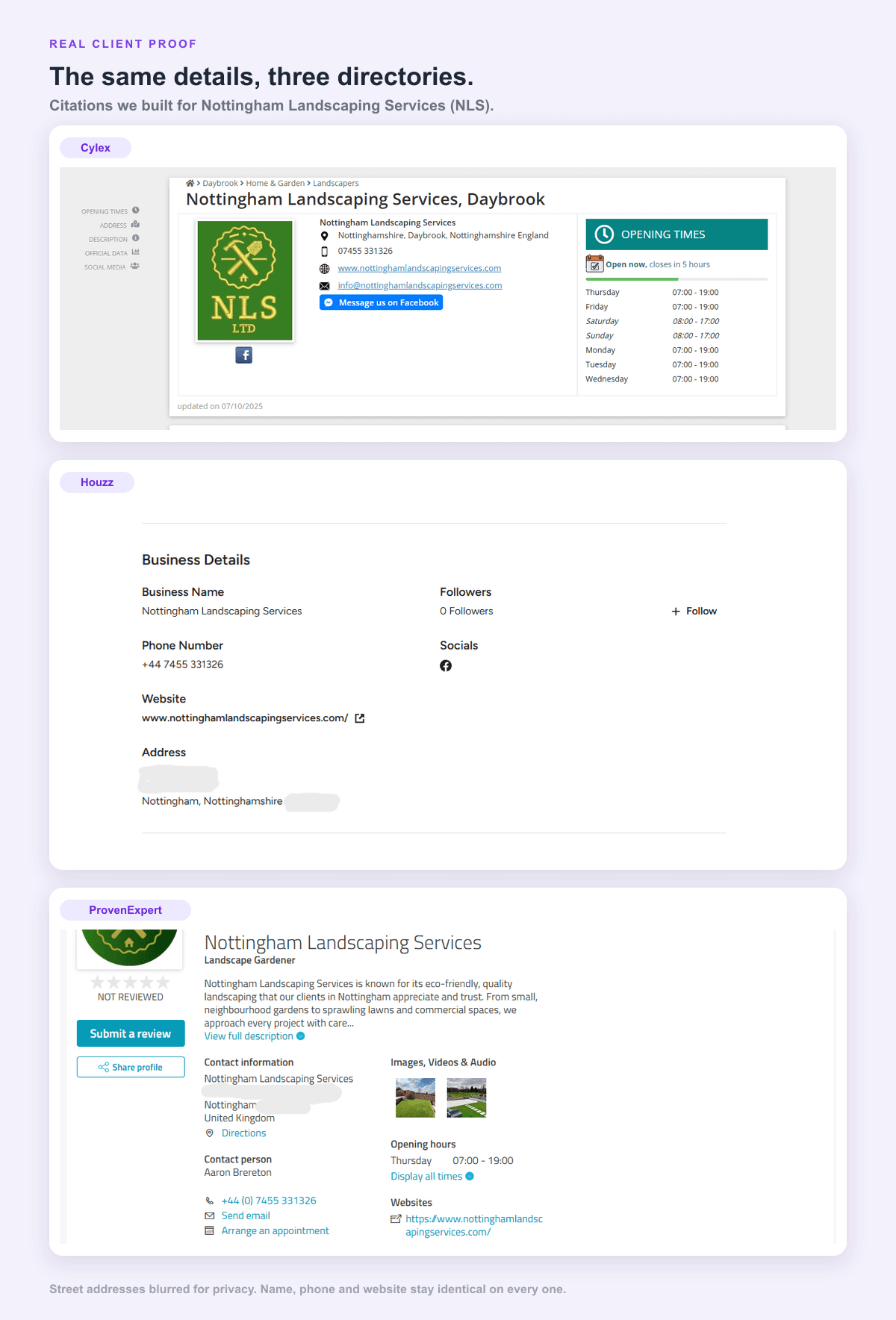
Citations are mostly a one-off job. Get listed on the sites that matter, make every detail match, then leave them alone. These four are free and a good place to start:
- Cylex UK, a large UK business directory
- Yell, the best-known UK listings site
- FreeIndex, another UK directory that's free to list on
- Bing Places, Bing's version of a Google Business Profile
3. Backlinks: the famous one, and the most abused
A backlink is a link from another website to yours. Google was built on the idea that a link is a recommendation: if sites people trust link to you, you're probably worth trusting too. That's still roughly how it works.
Not all links are equal, and this is where the cold emails catch people out. Take one real link from a local news site, a supplier, a trade body or a business near you. It's worth more than any number of links from sites that only exist to sell them.
A good off-page SEO service earns a few real links slowly rather than buying a job lot overnight. And links come last, because for a business working in one town, the profile, reviews and listings usually do more.
What to avoid
Off-page work happens away from your site, which makes it the easiest place to cut corners and get burned. Steer clear of anyone promising:
- A set number of links for a flat fee
- "Guaranteed DA50 links", or any promise about an authority score (a number invented by SEO tool companies, which Google doesn't use)
- Private blog networks (PBNs, sites set up only to link to other sites), link farms or link swaps at scale
Google's spam policies name buying links and link schemes as spam. At best these tactics do nothing. At worst they earn you a manual penalty, which is slow and awkward to get lifted.
What we do, and what you can do yourself
None of this is secret. On the sites we manage, the off-page work is steady and fairly boring. We keep the Google Business Profile complete and active, and the listings consistent. We make asking for reviews quick, write content worth linking to, and earn a few real links over time. Then we judge it on enquiries, not an authority score. Here's how to track whether your SEO is working.
If your site passed the test above, start with the free jobs. Claim and complete your Google Business Profile. Ask every happy customer for a review, the same way each time. Then get your name, address and phone number the same everywhere. None of it costs a penny.
Frequently asked questions
What is off-page SEO in simple terms?
Off-page SEO is everything away from your own website that tells Google you're a real, trusted business worth showing. For a local business that mainly means your Google Business Profile and its reviews, your listings on directories (called citations), and links from other websites. On-page SEO is what you put on your site. Off-page SEO is what the rest of the web says about you.
How is off-page SEO different from on-page SEO?
On-page SEO is everything on your own website that you can log in and change: titles, headings, the words on each page, images and speed. Off-page SEO is everything on the rest of the web that shapes how Google sees you: your Google Business Profile, reviews, directory listings and links from other sites. You control on-page directly. Off-page you earn over time.
Should I do on-page or off-page SEO first?
On-page first. Give every page a proper title with the service and the town in it, build a page for each service you want work for, and mention the areas you cover. Then complete your Google Business Profile and start asking for reviews, make your listings match, and leave links until last. Off-page work done before the site is right tends to underperform, because reviews and links work best when Google can connect them to a page about that job in that town.
How do I know if my website's problem is on-page or off-page?
Search Google on your phone for your main service plus your town. If you don't appear at all, or the wrong page of your site appears, that points to on-page: Google can't work out what the site is for. If you're on page two or three behind firms with more reviews and more listings, or missing from the map pack, your on-page is doing its job and off-page is what's missing.
Does a small local business really need off-page SEO?
Yes, once the website is right, though probably not the way the cold emails suggest. For most local businesses the off-page work that pays off is unglamorous: an active Google Business Profile, a steady flow of real reviews and listings that match. Get those sorted before you spend a penny on links.
Are Google reviews on-page or off-page SEO?
Off-page, along with the rest of your Google Business Profile, because they live on Google rather than on your website. They're also the most valuable off-page asset a local business has, because they feed the map pack. Make them the first off-page job once your on-page basics are sorted.
Is off-page SEO the same as link building?
Link building is one part of off-page SEO. Your Google Business Profile, reviews and citations count too, and for a local business they usually matter more than links. Treating off-page SEO as buying a batch of backlinks is the mistake that gets people burned.
Do backlinks still work in 2026?
Real ones do. A link from a real, relevant website still works as a recommendation that Google pays attention to. For a business working in one town, though, a complete Google Business Profile, steady reviews and matching listings usually do more, so links come last. Buying links in bulk, or using link farms and private blog networks, does nothing useful and can get a site penalised, because Google's spam policies target those schemes directly.
Can off-page SEO hurt my rankings?
It can, if you cut corners. Buying large numbers of low-quality links, using private blog networks, or spamming directories can earn a Google penalty that is slow and awkward to recover from. Done properly, with consistent citations, real reviews and a small number of real links, off-page SEO only helps.
Do I need to pay for both on-page and off-page SEO?
Not at the same time, and not always both. On-page is mostly a one-off fix with some upkeep. Off-page is ongoing, because reviews, listings and links build over months. Plenty of local businesses get the on-page done properly, do the free off-page jobs themselves, and only pay for off-page help once they're up against busier competition.
Done the test and still not sure? Run your site through our free website audit to see whether the on-page side is the problem, and what we'd fix first. If it comes back clean and you're still stuck on page two, the work is off-page. Book a free call and we'll go through your Google profile, your listings and your links, and tell you straight what's worth doing.